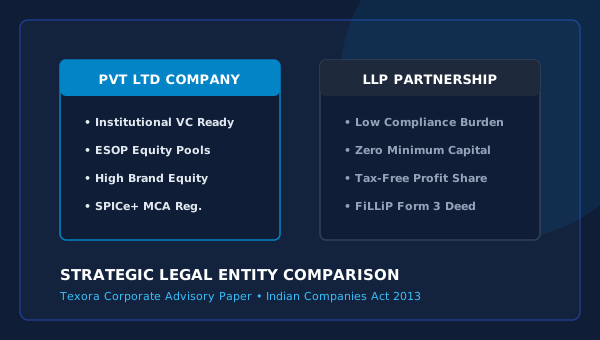
When launching a commercial enterprise in India, founders routinely encounter the central dilemma: Should we incorporate as a Private Limited Company (Pvt Ltd) or form a Limited Liability Partnership (LLP)?
Both legal structures deliver crucial limited liability protection, insulating personal assets from business liabilities. However, their statutory operational mechanics diverge significantly in fundraising flexibility, taxation, and annual regulatory compliance burden.
1. Capital Infusion and Investor Readiness
If your business trajectory involves raising venture capital, onboarding angel syndicates, or granting Employee Stock Options (ESOPs), a Private Limited Company is virtually non-negotiable. Institutional investors prefer the clearly demarcated share capital structure, preferred stock issuance mechanisms, and established exit options governed by the Companies Act, 2013.
In contrast, an LLP is primarily designed for service professionals, consulting agencies, and lifestyle businesses where capital is injected as partner contribution rather than tradable shares.
2. Compliance Overhead & Secretarial Mandates
Private Limited companies are subject to rigorous statutory secretarial mandates:
- Mandatory statutory audit regardless of turnover.
- Holding at least 4 board meetings every calendar year.
- Annual return filings in Form AOC-4 and MGT-7.
- Formal statutory registry maintenance under Section 88.
LLPs enjoy much lighter compliance overhead. An LLP requires a statutory audit only if annual turnover exceeds Ôé╣40 Lakhs or partner capital contribution crosses Ôé╣25 Lakhs, making it significantly more economical to maintain for lean operations.
3. Tax Implications on Profit Distribution
Corporate profits in a Private Limited company are subject to 22% (or 25%) corporate tax, plus applicable surcharges. When post-tax profits are distributed as dividends to shareholders, they are taxed in the hands of individual recipients at their respective income tax slabs.
In an LLP, the firm pays 30% flat tax on net income, but profits distributed to partners thereafter are completely exempt in the partnersÔÇÖ personal hands under Section 10(2A) of the Income Tax Act.
Conclusion
Choose a Private Limited company if high growth, investor backing, and ESOP talent recruitment are top priorities. Choose an LLP if you are building a profitable service agency, boutique consultancy, or professional firm seeking minimal secretarial compliance overhead.